
Pinellas County Release Records
A Pinellas County release closes one custody episode. It does not always mean the person returned to the community. The Pinellas County Sheriff's Office, or PCSO, may release someone on bond, after time served, or under a court order. PCSO may instead transfer that person to the Florida Department of Corrections, another county, the U.S. Marshals Service, or immigration custody. Each event ends the county booking, but only some end confinement.
The best proof joins several records. The PCSO booking detail supplies a status and release time for recent episodes. Inmate Records can produce the release screen, log, authorization, and transfer detail. The Pinellas Clerk keeps the case disposition and sentence. Florida Department of Corrections records become vital after a state transfer or for state supervision. A missing name alone proves none of these events.
- Discharge
- The documented end of an agency's custody or supervision episode.
- Time served
- A sentence outcome crediting confinement already completed.
- Detainer
- A request or hold that can send a person to another authority.
- Expungement
- A legal process that can sharply restrict ordinary public access to a qualifying record.
Pinellas County Release Types
The exit label determines the next search. Bond and pretrial release leave the criminal case open. A completed county sentence can end the custodial part of an order while probation or another case remains. A transfer ends PCSO control but moves the person into a new system. The release line and receiving agency matter more than the fact that a name left the active jail list.
| Exit type | Meaning | Next record |
|---|---|---|
| Bond or pretrial release | Community release while the case remains pending | PCSO timestamp and Clerk order |
| Time served or sentence complete | The custodial term shown by the order was met | Release record and sentencing docket |
| Dismissal or acquittal | A case outcome, though another hold may remain | Filed Clerk disposition |
| FDC transfer | County custody ended and state custody began | FDC offender detail |
| Other agency transfer | Confinement may continue with a county, USMS, or ICE | Named receiving system |
Note: A release from Pinellas County Jail describes PCSO custody only and cannot by itself establish freedom from all custody.
Pinellas County Release Fields
A recent PCSO detail ties the release to one booking episode. That distinction prevents a past release from being confused with a later arrest. Searchers should preserve the exact labels and connect the docket or court case number to the Clerk. Bond data may explain a release, but it is not proof that physical release occurred.
| Field | What it shows |
|---|---|
| Full name and aliases | Identity keys that still require a second matching fact |
| Docket and booking date | The specific PCSO custody episode |
| Arresting agency | Who initiated the booking, not always who ordered release |
| Charge and case number | The bridge to the Clerk docket and outcome |
| Cell Location/Status | The release timestamp and mechanism on a recent detail |
| Release type or receiving agency | Whether the exit was community release or transfer |
| Proj Release Date | A county projection field that may read NONE |
| Booking photograph | An image tied to that arrest episode, not proof of guilt or present custody |
The official PCSO released booking example shows how status, charges, identifiers, and a photo can share one detail screen.
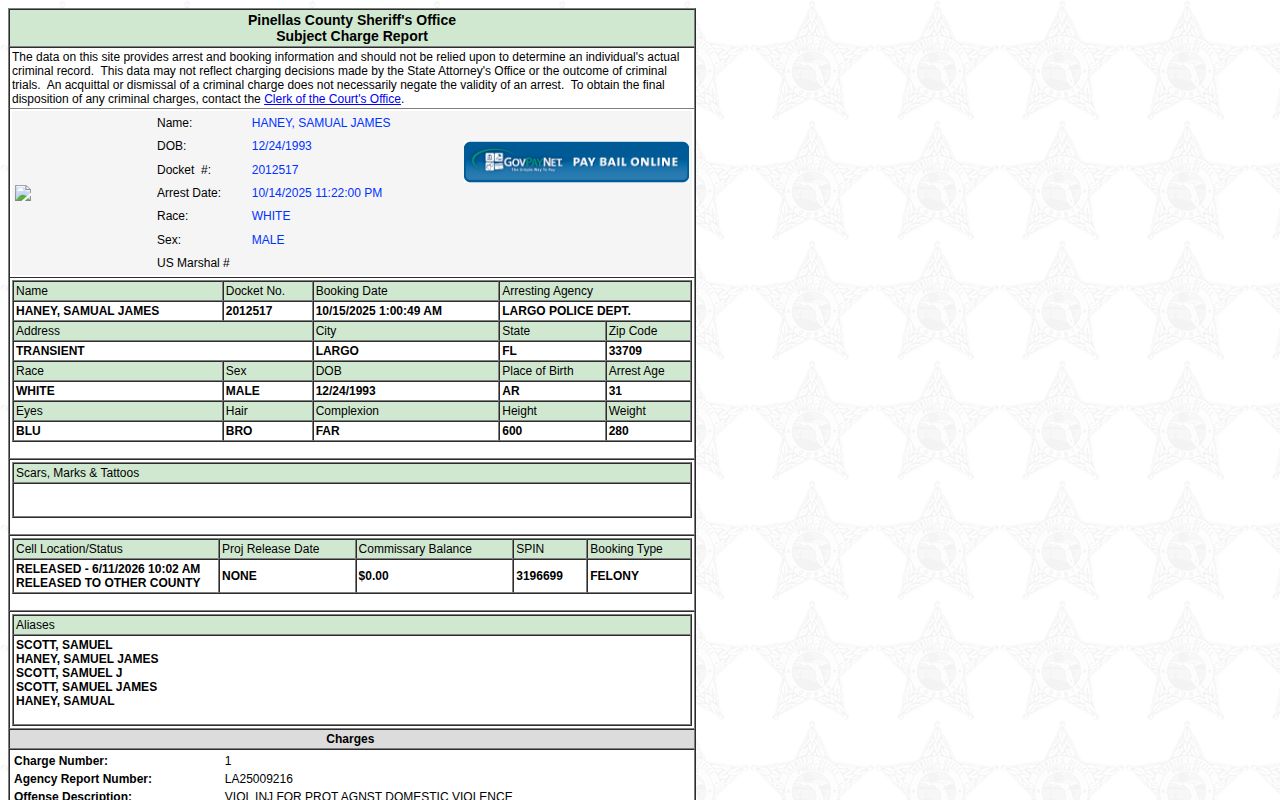
The status line is the key release evidence. The surrounding fields help confirm that the record belongs to the right person and booking.
When Pinellas County Releases Inmates
PCSO publishes a process, not a fixed gate time. A person called from a jail unit gathers personal and jail-issued belongings, goes through dress-out, receives property, and receives money at a separate point. When a judge orders release, Inmate Records must still clear the paperwork and check other holds. PCSO warns that this review can take several hours.
An eligible courtroom release also depends on an approved, prefiled application and clearance. Someone wearing jail clothing returns through the normal process. The court ruling time and physical release time can therefore differ without a record conflict. For confirmation, use the later PCSO status timestamp rather than an estimate based on the hearing.
Pinellas County Bond Releases
PCSO lists surety, cash, and AllPaid card bond channels. AllPaid card bonds are limited to amounts up to $2,500 per charge and include a nonrefundable service fee. The Sixth Judicial Circuit's uniform bond schedule guides law enforcement but does not bind a judge, and some charge groups require first appearance. A payment route never proves that release was cleared.
A bond release is also not a completed case. The PCSO release timestamp shows the end of jail custody, while the Clerk docket shows later hearings and disposition. Pre-Trial Services may impose check-in duties under the court's terms. Read the actual order and the PCSO status rather than assuming that a bond amount equals an immediate exit.
Request Pinellas County Release Records
The online PCSO display includes released people for thirty days. That is a display window, not a destruction rule. Older proof moves to the PCSO Records Section. A narrow request should name the person, docket number if known, approximate booking and release range, and the exact documents needed. Ask for the booking sheet, release screen or log, release date and time, release reason, authorization, receiving agency, and booking photograph when relevant.
- Check the PCSO Arrest Inquiry and save the correct docket and booking date.
- Open the PCSO GovQA portal, or contact the Records Section by email, phone, mail, or in person.
- Describe the episode and each requested record. State whether transfer documentation or the booking image is needed.
- Review PCSO's availability and cost notice. Pay the quoted amount before production when required.
- Use the Clerk for the filed release order, disposition, judgment, or sentence.
10750 Ulmerton Road, Largo, FL 33778
727-582-5865
prr@pcsonet.com
Mail: P.O. Drawer 2500, Largo, FL 33779-2500
PCSO publishes no fixed price or turnaround for this exact package. It reports what is available, gives any cost, and requires payment before production. Florida's general copy rules do not justify inventing a flat quote for a request that may need review or redaction.
Florida Law on Pinellas Releases
Florida Constitution article I, section 24 and Chapter 119 form the public-record framework. Section 119.07 generally permits inspection and copying at reasonable times and conditions. It lists common paper-copy amounts, but extensive clerical or technology work can bring a reasonable special-service charge.
Access still has limits. Sealed, expunged, juvenile, victim-sensitive, medical, and security information can be withheld or redacted. FDC records also face section 945.10 confidentiality rules. Thus, an empty online search can reflect age, restricted access, data lag, or a legal access change. It does not prove that no Pinellas County booking occurred.
Pinellas Release Record Expungement
Pinellas County publishes a local seal and expunge checklist. The process begins with an FDLE eligibility packet and certificate plus a certified final disposition, followed by filing at the Justice Center. The checklist states a $75 FDLE charge. The Clerk schedule lists a $42 local filing charge, with copy and certification costs added when applicable. It also warns that the process can take months.
Sealing makes a qualifying record confidential and exempt subject to statutory access. Expunction generally directs covered agencies to destroy or obliterate material while FDLE keeps a confidential record. Neither step should be described as instant deletion of every old reference. Eligibility and the actual court order control what changes.
Note: A missing Pinellas County release record may reflect lawful access limits, so absence alone should not be treated as a factual result.
Search Pinellas County Released Inmates
Begin with the agency that held the person. For a county booking, search PCSO by a broad name spelling, docket, or booking date. Open the correct episode and read Cell Location/Status. If that entry names another authority, follow the receiving system. Use the Clerk to explain the legal result, FDC for state custody or state felony supervision, BOP for federal custody, and ICE only when immigration custody is plausible.
- Match at least two identifiers, such as name plus docket, booking date, birth date, case number, or agency number.
- Read the PCSO release time and mechanism. Do not infer release from disappearance.
- Search the Pinellas Clerk by case number and include inactive cases for older matters.
- Follow a state transfer or supervision entry into the appropriate FDC dataset.
- Use VINELink as a status and notice layer, then verify the event with PCSO, FDC, or the court.
- Use BOP or ICE only for the custody category each system covers.
- Request the source document when an online entry is missing, old, abbreviated, or unclear.
Florida Search for Pinellas Releases
The Florida Department of Corrections separates inmate population, inmate releases, supervised population, absconders, and an all-databases search. A Pinellas County Jail release that never entered FDC may not appear there. For a past or scheduled state-prison release, choose Inmate Release Information Search. If the state category is unclear, use the all-databases option.
| Search item | Use | Caution |
|---|---|---|
| DC number | Best match; six digits or one letter plus five digits | Do not substitute a county docket |
| Name | First and last name prefix search | Match birth date and case facts |
| Release Date | Displayed state release event | Check final Date Out-Custody too |
| Current Release Date | Current projected date for an in-custody record | It can be recalculated |
| Current status/location | Shows custody or supervision context | A movement may be a transfer |
The official FDC Offender Search provides the menu for these distinct state datasets.
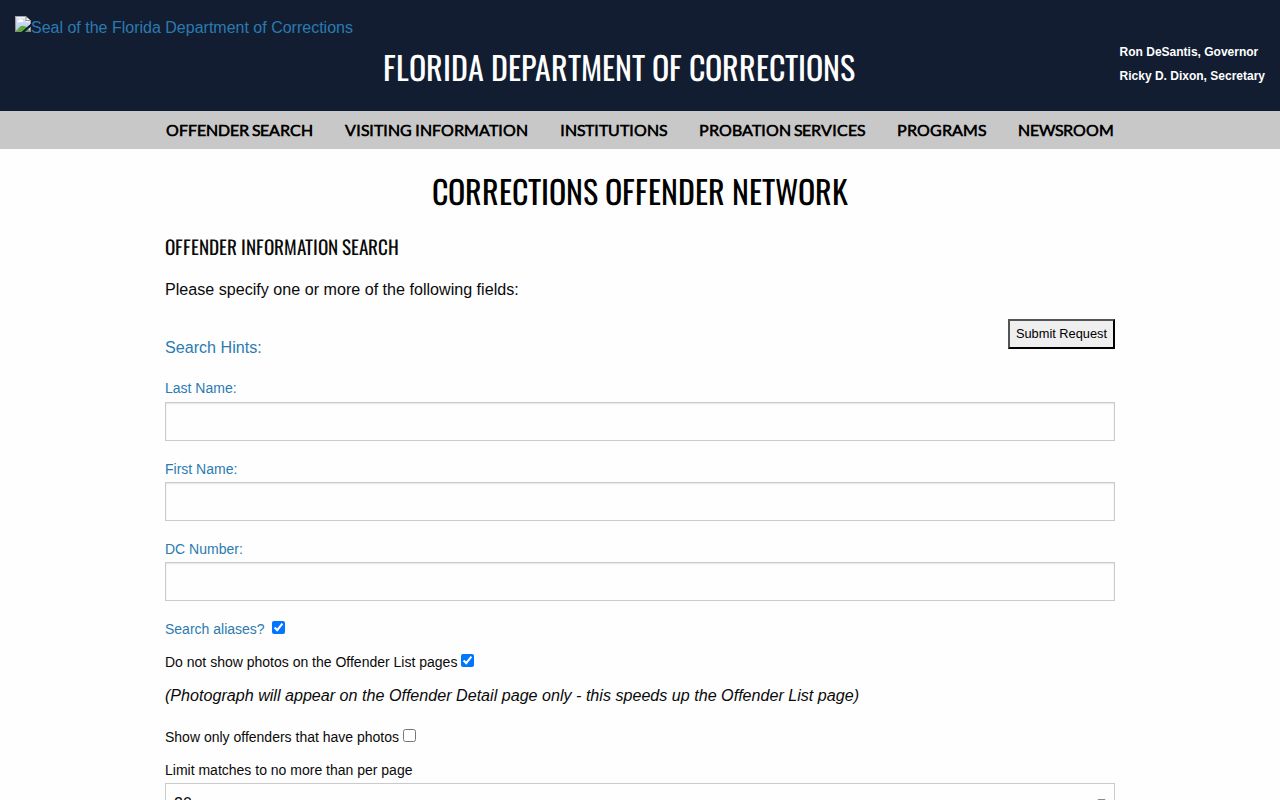
Choose the dataset before searching. The current inmate list and the released-inmate archive answer different questions.
Recent Pinellas County Jail Releases
PCSO publishes no distinct rolling twenty-four-hour or seventy-two-hour feed. Its official Arrest Inquiry is broader: current detainees and people released during the prior thirty days. The form accepts booking date, not a complete release-date filter. Someone booked days earlier and released today could be missed by a search limited to today's bookings.
For a known person, open the detail and read the status timestamp. PCSO does not promise a fixed refresh interval. A just-completed release may lag, and a transfer can appear as a release from the jail even though custody continues. For older records, move to GovQA and the Clerk rather than relying on the live inquiry.
Pinellas County Daily Release Context
A county Sequential Intercept Mapping report recorded a workshop-era estimate of about 87 jail bookings and 85 releases per day, with an average stay of 30 days. These figures came from a planning workshop and are not a live PCSO counter. They explain why a name-based search is more reliable than trying to reconstruct a complete daily list from booking dates.
Only the last figure describes the current public inquiry's stated scope. The planning estimates must remain tied to their report context.
Pinellas Court Records After Release
The free Clerk Public View often survives the PCSO display. Search by the PCSO court case number when possible, since names can collide. For an older party search, select Include Inactive Cases. Then read the docket and filed documents for release orders, bond action, disposition, judgment, sentence, credit for time served, probation, violations, and termination.
A missing document icon is not always the end. Public View can route a View on Request item through an email cart, and older unimaged records have an email request path. The court record explains the case. PCSO records when physical custody ended. Those neighboring systems describe different acts and may carry different times.
Pinellas County Post-Release Supervision
FDC maintains state felony probation, community control, and other community-supervision records. PCSO separately handles local misdemeanor probation and pretrial functions. Florida parole belongs to the narrow population still eligible under the state's historical offense rules and decisions of the Florida Commission on Offender Review.
An FDC supervised record can show the supervision start, status, type, location, and scheduled end. Active Suspense often means the person is temporarily unavailable for direct supervision, such as during another jail stay. Absconder means alleged noncompliance, unknown whereabouts, and a violation warrant. Neither term means a clean discharge from legal control.
Pinellas County Release Support
Pinellas County Justice Coordination maintains an official Community Re-Entry Resources hub and a navigation line at 727-453-7441. The hub links to identity documents, transportation, court and probation help, and other local services. PCSO's handbook also describes pre-release access to an assigned-area social worker and the round-the-clock 211 referral line.
These services help with planning, not proof. Participation does not establish that a person was released, and a referral does not replace the PCSO timestamp or FDC record. Confirm custody first, then use the resource channel for practical support.
Property After Pinellas County Release
The PCSO handbook allows a request to mail property during confinement or within thirty days after release or transfer. It uses an electronic Release of All Property request plus a paper postage form with recipient contact details. The outside recipient generally needs valid photo identification, and the rules ordinarily require all property to be released subject to stated exceptions.
This jail-property route differs from Property and Evidence held for an investigation. For replacement identity papers, the county Important Documents page links official channels. While a person remains confined, a projected-date concern goes to Inmate Records through a kiosk or tablet Inmate Request. After release, use PCSO Records or Inmate Records rather than assuming an unpublished correction form exists.
Note: The property mailing window follows a release or transfer, but the property request itself is not proof of either event.
Travel After Pinellas County Release
PSTA Route 49 serves the Pinellas County Justice Center corridor and publishes a timepoint at 49th Street North and 140th Avenue North, close to the jail compound. It is ordinary public transit, not transportation supplied by the jail. Riders should check the current schedule and stop conditions before relying on it.
Timing remains uncertain because PCSO gives no fixed release hour. Court clearance, records checks, dress-out, property return, and money return can extend the process. A ride plan should use the verified physical release, not just the time of a hearing or a projected field.
Pinellas Release Alerts and Transfers
VINELink can provide an agency-fed status and notification layer. Select Florida, confirm that the relevant Pinellas or FDC agency appears live, match one person, and register from that exact record. A VINE release notice still needs confirmation through PCSO, FDC, or the court because the event may not state whether custody shifted elsewhere.
For federal custody, the BOP Inmate Locator covers records from 1982 forward and updates daily. A past release date with no location, or a Released or Not in BOP Custody result, ends only BOP custody. The ICE detainee locator is mainly for current adult detainees and may show some releases within sixty days. USMS has no general public release locator. Follow the federal court docket and BOP when a PCSO status names a Federal Marshal hold.
Pinellas Released Versus In Custody
The same name can appear differently because each database follows its own episode. Use the system that matches the custodian, then read an affirmative status or date.
| Situation | First source | Confirmation |
|---|---|---|
| Recent Pinellas jail release | PCSO Arrest Inquiry | Status timestamp and release record |
| Older Pinellas jail release | PCSO GovQA and Clerk | Archived release document and court order |
| Florida prison release | FDC Inmate Release Search | Release Date and Date Out-Custody |
| State supervision | FDC Supervised Population | Current status and termination fields |
| Federal release | BOP locator | Past release date and no BOP location |
| Possible immigration custody | ICE ODLS | Locator result plus agency or case documents |
Safe Harbor and Pinellas Releases
PCSO places Pinellas Safe Harbor next to the jail and describes it as a diversion and service site. It is not a detention facility and has no separate custody roster. A person may discuss discharge planning with a social worker before release, with service access based on current suitability and availability.
The geographic link can be useful, but it cannot confirm release. A Safe Harbor referral or service contact must never replace the PCSO booking status, release log, or receiving-agency record.
Pinellas County Release Facilities
Pinellas County has one PCSO jail compound and four verified state community-custody facilities. South, Central, and North are divisions of the single county jail, not separate public search systems. The former Pinellas Community Release Center closed and is not in the current map.
- Pinellas County Jail: PCSO booking and release records cover the compound.
- Largo Road Prison: FDC custody may end in transfer, community placement, supervision, or discharge.
- St. Petersburg Community Release Center: placement remains state custody until FDC records release.
- Tarpon Springs Community Release Center (TTH Tarpon): the contract proves operation, while FDC supplies individual status.
- Suncoast Community Residential Center: this contract community placement also uses the FDC offender record.
The county inquiry should not be used as the governing record for the four FDC facilities. Search by DC number and distinguish a move within state custody from final release.