
St. Petersburg CRC Release Meaning
St. Petersburg Community Release Center is an FDC community-custody facility and a component in the Polk Correctional Institution staffing plan. It is not the Pinellas County Jail. Residents remain within Florida's state corrections system even when work release or another approved activity takes them into the community. A facility name that includes “release” must not be read as a completed discharge status.
Movement away from the center can take several forms. FDC may transfer a person to another institution or community center. It may return someone to a secure setting. A person may leave confinement for state supervision, or the sentence may reach final release. Each path has a different legal effect. The statewide offender record, not the PCSO Arrest Inquiry, supplies the main custody and release history.
| Recorded path | Custody effect | Where to verify |
|---|---|---|
| Placement at the center | FDC custody continues | Inmate Population detail |
| Transfer or return | FDC custody continues elsewhere | Current location and history |
| Release to supervision | Confinement ends; supervision continues | Release and Supervised Population records |
| Final discharge | The stated FDC term ends | Release and termination fields |
Search St. Petersburg CRC Release
Use the FDC Offender Search. Its datasets separate current inmates, released inmates, supervised people, and absconders or fugitives. Choose the Inmate Release Information Search when a state release is known or expected. Choose Search All Corrections Offender Databases if the current category is uncertain. The Inmate Population search is the better starting point for a person believed to remain at the center.
- Search the six-character DC number for the strongest match.
- If it is unknown, search the name and use documented identity details to narrow the results.
- Open the detail and match birth date, sex, race, county, case, sentence, and photograph.
- Read current status and location before drawing any conclusion from the center's name.
- For a completed departure, record Release Date and Date Out-Custody plus any supervision status.
- Recheck after a short lag because FDC says release dates and locations generally update nightly.
County jail data is relevant only if the same person has a separate Pinellas booking. One agency's record does not replace the other. The Pinellas County release search paths explain how to keep state and county episodes apart.
St. Petersburg CRC Record Fields
FDC records commonly show the name, DC number, photograph, current custody or supervision status, location, sentence, offense, county, case number, incarceration history, and release-date information. Exact labels can vary by dataset and record era. Capture them as displayed. A current profile can contain Current Release Date, which is a projected calculation. It is not the same as Release Date or Date Out-Custody on a completed history.
A supervision result adds another layer. It may show Supervision Begin Date, Current Location, Current Status, Supervision Type, Scheduled Termination Date, aliases, and the supervision offense. “Active” means community supervision is under way. “Active Suspense” can mean the person is jailed or in another facility while FDC still monitors the case. “Absconder” means the agency alleges unknown whereabouts and a violation warrant, not that legal control ended.
- Community custody
- FDC placement with controlled community access while state custody continues.
- Current Release Date
- The date FDC currently calculates; it can change.
- Date Out-Custody
- A historical field tied to the end of an incarceration episode.
- Supervision termination
- The recorded end date for the state community-supervision term.
Note: Match the DC number and case data, not a photograph or shared name alone.
St. Petersburg CRC Records Request
The public profile may confirm status without showing the document that authorized a move. A focused FDC request can seek movement history, placement records, release calculations, release authorization, Date Out-Custody support, and community-supervision records. Give the person's name, DC number, St. Petersburg Community Release Center, and a narrow date range. State records can be reviewed for confidential material and redacted where Florida law requires.
Records Custodian James Best
501 South Calhoun Street
Tallahassee, FL 32399
850-717-9774
Fax: 850-488-4534
Central Records: 850-488-9859
Bureau of Admission and Release: 850-488-9167
dc.release@fdc.myflorida.com
The FDC public-record route is the verified path for state corrections documents. No research-supported street address, facility telephone, or public hours were established for St. Petersburg Community Release Center, so those details are not invented. The sentencing court is a separate source for the judgment and sentence.
St. Petersburg CRC Current Evidence
The 2026 FDC Polk Correctional Institution PREA audit confirms St. Petersburg Community Release Center within the Polk staffing plan. It describes two facility supervisory positions. That source establishes current organizational treatment, but it is not a person locator and does not report whether any named resident has departed. Facility evidence and individual status evidence serve different purposes.
Current facility placement should be checked through the offender search. The audit supports the center's place in the state system, while the live record addresses the person. A failed or missing search deserves a broader all-database search and a records request, not a conclusion that the person was discharged.
St. Petersburg CRC Supervision
Community release placement and community supervision are separate stages. Placement at the center remains custody. Supervision begins when an authorized release puts the person under FDC field oversight in the community. Florida uses several labels, including felony probation, community control, conditional release, and parole for a narrow eligible group. Copy the label in the record rather than using “parole” for every case.
FDC's Supervised Population search can establish a begin date, status, supervising location, type, and scheduled termination. It does not supply the county jail release timestamp. The Clearwater Circuit Office serves Pinellas and Pasco for state field supervision, but the person's detail should identify the actual supervising location. A later termination field can show that supervision ended.
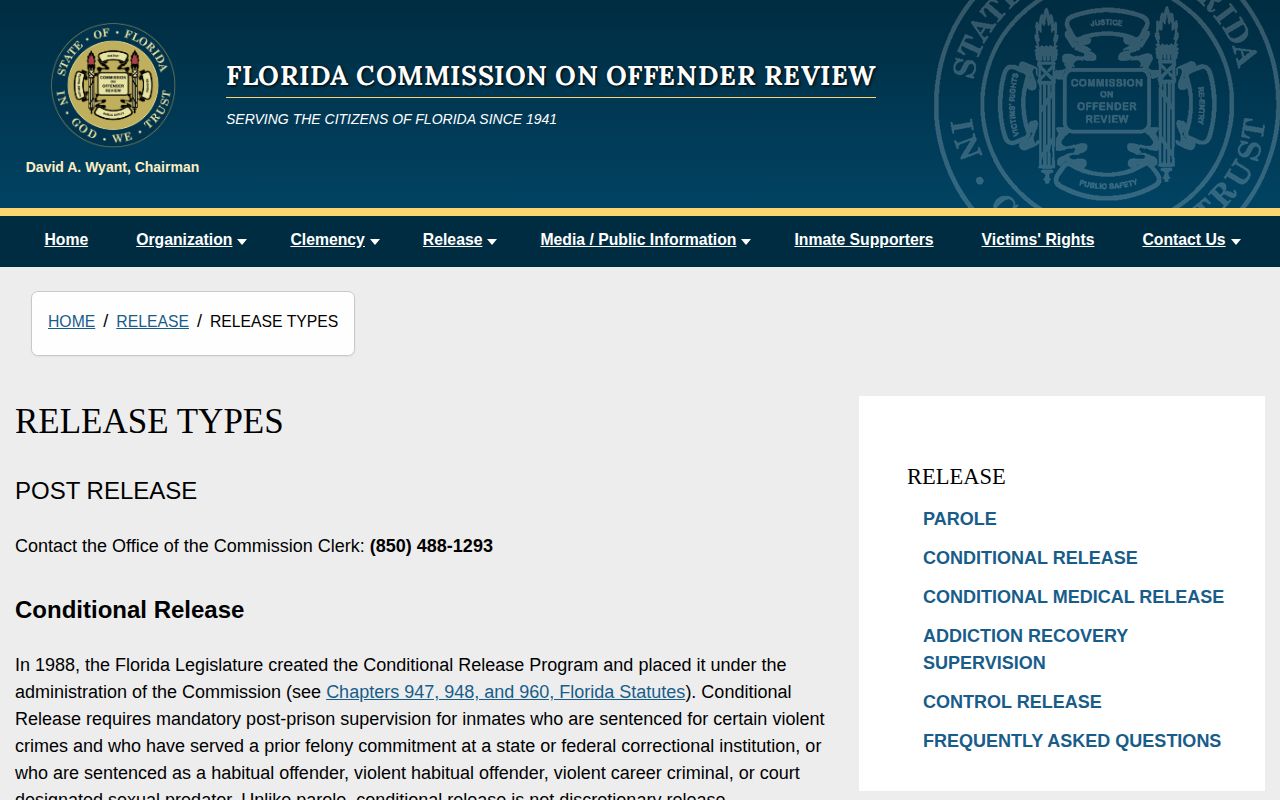
The official Florida release-type definitions distinguish Commission release categories. The image below preserves that state context.
After St. Petersburg CRC Departure
A final FDC release does not by itself resolve the underlying court case or prove that all supervision ended. Pair the release fields with the sentence and supervision record. If a detainer exists, another authority may receive the person when FDC custody ends. A detainer is a formal request from another agency to hold or transfer someone. The destination may therefore differ from the expected community plan.
If the record shows another FDC facility, continue with the same DC number. If it shows community supervision, read the type and supervising office. If it records Release Date and Date Out-Custody without a new state location, request the state release record when the destination still matters. A named receiving authority should then be followed in that authority's system.
How is final release confirmed? Use the completed FDC release fields and current status, then check supervision. The center name and a person's absence from the current population are not enough. That method preserves the difference between community placement, transfer, supervised release, and full discharge.
St. Petersburg CRC Date Changes
A Current Release Date can change while a person remains at St. Petersburg Community Release Center. FDC begins with the sentence and lawful court credit, then applies eligible gain time to a tentative date. Covered Florida sentences cannot be reduced below the statutory 85-percent floor. Awards and restoration can move the calculation earlier. Forfeiture can move it later.
Resentencing, amended jail credit, an added or consecutive sentence, and data correction can alter the inputs. Release planning and a detainer can affect the destination. A detainer is another authority's request to hold or receive someone, so the FDC sentence can end without a direct return to the community. Check the date again rather than promising it.
St. Petersburg CRC Identity Match
Match more than a name. The DC number is the strongest key across the FDC inmate, release, and supervision datasets. Compare birth date, sex, race, county, case number, sentence, aliases, and incarceration dates. A photograph is supporting context, not the sole identity test. One person can also have more than one sentence or state custody period.
A useful timeline keeps each event distinct: court sentence, FDC admission, arrival at the center, transfer or release, Date Out-Custody, supervision begin date, and supervision termination. Those dates can differ for valid reasons. If a profile abbreviates an offense or leaves out a movement, the court order and focused FDC record request provide the stronger explanation.
Note: An audit confirms the facility, but only the offender record can confirm an individual's status.