
Pinellas Projected and Actual Dates
Three fields can look alike but answer different questions. A PCSO booking detail may show Proj Release Date for the county episode. It can say NONE, especially when a person is awaiting trial, bond, court action, or transfer. An FDC state profile can show Current Release Date, the agency's current calculated date for a prison sentence. An Actual Release Date or Date Out-Custody records that an agency's custody episode ended.
Actual release is retrospective. Projected release is a forecast based on the lawful information then in the file. A person can leave PCSO custody and enter FDC, another county, federal, or immigration custody. In that event, the Pinellas release timestamp is real, but it is not a return to the community. Read the release mechanism or receiving agency.
Pretrial detention has no sentence to compute. Bond can be posted, a judge can issue an order, charges can change, or another hold can block departure. The Pinellas Clerk case and PCSO status are better sources than an estimated date in that setting.
Find a Pinellas Projected Date
Start with the custodian, not just the name. PCSO governs the county booking and county-sentence calculation. The Florida Department of Corrections governs a state-prison sentence. The Pinellas Clerk holds the signed sentencing order and court-awarded jail credit. Each date can be valid within its own record.
- Confirm the current custodian. Search PCSO for a Pinellas County Jail episode or FDC for state custody. A county transfer to FDC closes the jail episode but starts a different one.
- Match at least two identifiers. Use the PCSO docket or case number for the county episode and the six-character DC number for an FDC profile whenever possible.
- For a county sentence, read the sentencing order and ask Inmate Records for the calculated date. If the person is still confined and sees a discrepancy, PCSO directs an Inmate Request through the kiosk or tablet.
- For state prison, open the FDC detail and record Current Release Date, status, location, and the date checked. Do not rely on an inmate-list row alone.
- After the date passes, look for Release Date or Date Out-Custody. Read the receiving path to determine whether custody continued elsewhere.
The official FDC detail example with a Current Release Date shows where the state field appears.
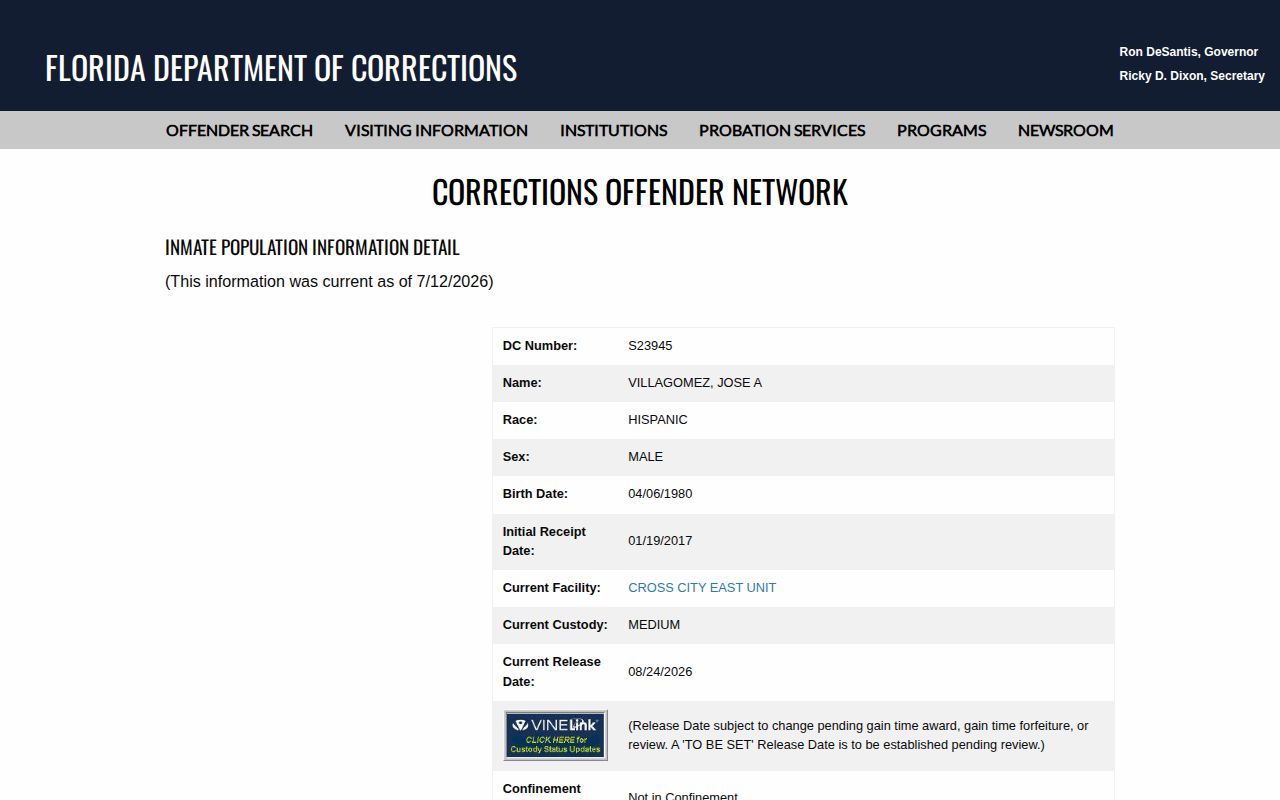
The field should be saved with the date checked because later credits, losses, court changes, or data corrections can alter it.
For the full county release timestamp and older-record route, use the Pinellas County released-inmate records search after identifying the correct custody episode.
Note: A name missing from a live jail list does not prove release; use the episode status and source record.
Florida State Release-Date Math
FDC begins with the sentence and lawful court credit. It establishes the maximum sentence expiration date, then applies eligible gain time to form the statutory tentative release date. Florida Statutes section 944.275 uses those terms. An award or restoration can move the tentative date earlier. A forfeiture can move it later, but not beyond the maximum expiration date.
For covered offenses committed on or after October 1, 1995, section 944.275 permits up to ten days per month of incentive gain time, subject to exclusions and FDC review. The same law sets a truth-in-sentencing floor. Gain time cannot cause service of less than 85 percent of the sentence, with court credit for time physically confined counted. Life remains life unless a lawful sentence change, clemency, or pardon applies.
These are system rules, not a do-it-yourself promise. Offense dates, excluded offenses, consecutive terms, court credit, and later discipline all matter. Record FDC's displayed date and recheck the profile instead of subtracting a flat percentage from the sentence.
The statute page captures the rule used in a Pinellas County state-prison calculation. View the official gain-time and 85-percent provisions with the related screenshot below.
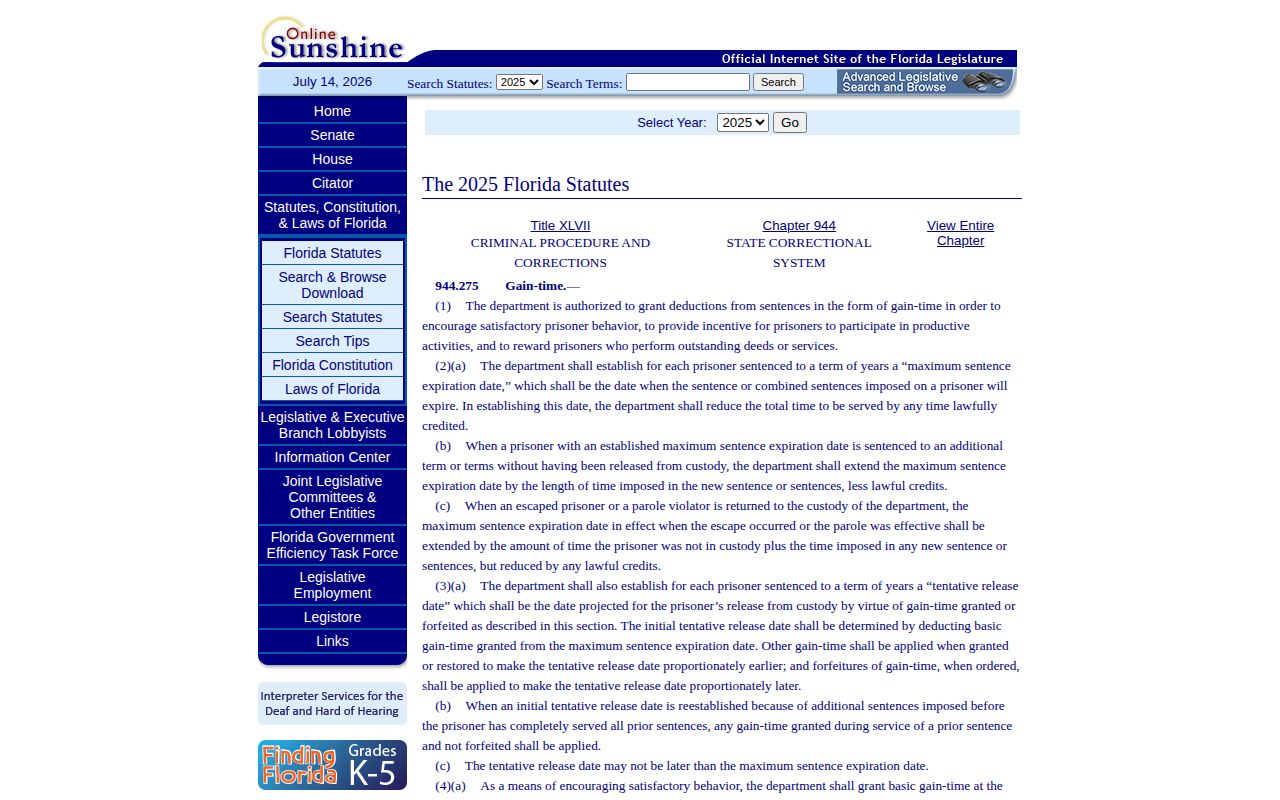
The statute explains the statewide formula, while the FDC offender detail shows the result for one state record.
Why Pinellas Release Dates Change
A projected date changes when its inputs change. Some events alter the date itself. Others leave the sentence-end date intact but change where the person goes. A detainer is a request or legal hold from another authority. It may lead to a transfer when the Pinellas or FDC term ends, so the person is released from one agency but not necessarily free from custody.
| Factor | Possible effect | Best source |
|---|---|---|
| Gain-time award or restoration | May move an eligible FDC tentative date earlier | FDC calculation and section 944.275 |
| Disciplinary forfeiture | May move an FDC date later | FDC record or records request |
| Resentencing or amended jail credit | Changes the sentence input or credit | Signed court order and agency recalculation |
| New or consecutive sentence | Can extend the overall custody term | Court dockets and FDC sentence history |
| Detainer or agency hold | May change the destination after release | Release or transfer record naming the agency |
| FCOR parole action | May establish, deny, defer, or change a release path for an eligible case | FCOR action sheet or order |
| Data correction | Can revise the displayed date without a new sentence | Agency record and date checked |
FDC says release dates and locations update nightly, while some population data and photographs refresh weekly. A short lag is possible. That schedule is a reason to recheck, not a basis to invent a date.
Confirm Pinellas Actual Release
For a Pinellas jail episode within the online window, open the PCSO booking detail and read the Cell Location/Status line for an actual timestamp and mechanism. A projected field that says NONE does not conflict with a recorded bond release or transfer. It answers a different question. For older episodes, ask PCSO Records for the release screen or log, exact release date and time, reason, authorization, and receiving-agency entry.
For FDC custody, the released-state-prison record should show Release Date and the last incarceration Date Out-Custody. A state profile may also show supervision after prison. If the release involved parole or another FCOR program, the Commission action supplies the legal decision. For county or state cases, the court record explains the sentence but may precede physical release while holds are cleared.
VINELink release notifications for Pinellas County can add an alert, but VINE is not a certified release instrument. Confirm Pinellas County Jail participation in the live agency picker, then verify any event against PCSO, FDC, or the court.
Pinellas County Sentence Credits
Pinellas county-jail rules differ from FDC's state-prison formula. Florida Statutes section 951.21 authorizes county good-conduct commutation unless changed locally. It sets maximum bands and permits optional meritorious credit. The Pinellas inmate handbook gives the applied local details and should be read with the signed sentencing order.
PCSO describes Gain Time of five days for each 30 days of a county sentence, with none for terms of 29 days or less. It excludes civil-contempt orders, sentences that state exact time, and cases with judicial exclusions. The handbook also describes Good Time of no more than five days per month after gain time and court credit, subject to disciplinary loss. Staff calculate the date at sentencing, and no one is released until the date is verified.
A county inmate who questions the displayed or stated date should use an Inmate Request to Inmate Records while confined. The request should identify the sentence and claimed discrepancy. After release, a narrow PCSO records request can seek the release calculation and source documents. This county process must not be replaced with the FDC 85-percent rule.
Note: County gain time and FDC gain time are separate systems even when the underlying case began in Pinellas County.
Pinellas Release-Date Custody Paths
The same person can have several dates because each system records its own episode. A PCSO booking date begins a county episode. A court sentence date creates the legal term. A transfer date may end the county episode and begin state custody. FDC then calculates its own current release date. A later Date Out-Custody ends that state incarceration episode, while community supervision may continue.
- PCSO Proj Release Date
- A field tied to one Pinellas County Jail booking episode; NONE can be a valid entry.
- FDC Current Release Date
- The current state calculation displayed for an FDC inmate.
- Tentative release date
- The statutory state date after lawful gain time is applied.
- Date Out-Custody
- Historical proof that the recorded FDC incarceration episode ended.
- Detainer
- A hold or request from another authority that can alter the next destination.
Write down the agency with every date. That one habit prevents the common error of treating release from Pinellas County Jail as release from all custody.
Pinellas Release-Date Record Requests
Online screens can be incomplete, restricted, or outside their display window. For a Pinellas jail calculation, request the booking sheet, sentencing credit used, projected date calculation, actual release screen or log, release authorization, and any receiving-agency entry. Give PCSO a narrow date range, full name, docket number, and court case number. The GovQA portal allows tracking and download, while the Records Section also accepts phone, email, in-person, and mail contacts.
For an FDC sentence, use the FDC Public Records Center and provide the DC number, the exact date range, and the specific sentence, gain-time, movement, or release documents sought. FDC may review records for confidential material and give an estimate. The released-person search is faster for a routine check, but the source record is the better route when a date changed or the destination is unclear.
The Pinellas Clerk remains the source for the signed sentence, amended judgment, credit for time served, and later resentencing order. Use the same case number across PCSO, the Clerk, and FDC. If those sources show different dates, compare what each date labels before treating the records as a conflict. Court entry, physical release, agency transfer, and database posting rarely occur at one instant.
Ask for the date as it appeared on a specific day when tracing a change. A current screen may show only the revised calculation, while a dated record response can explain the older value. State whether the question concerns the maximum expiration date, tentative release date, current displayed release date, or actual out-custody date. Clear labels help the records custodian return the right document and keep a projected date from being confused with the completed release event.
A record older than PCSO's 30-day online window is not presumed destroyed. The sheriff's own inquiry directs older matters to the records portal. Keep the response and the date checked with any projected date so later changes can be traced.