
Pinellas Parole and Probation Compared
Parole is an early release from a prison sentence for a person who falls within Florida's limited parole framework. The Florida Commission on Offender Review, or FCOR, makes the parole decision, while field supervision records may appear through the Florida Department of Corrections. Probation is a court sentence served in the community instead of, or after, time in custody. FDC maintains state felony probation and community-control records. The Pinellas County Sheriff's Office handles local misdemeanor probation and several pretrial programs. A court order and the agency record should agree, but each serves a different role.
The word "parole" is often used loosely. That can send a search to the wrong office. Florida largely ended parole eligibility for most crimes committed on or after October 1, 1983, while narrow offense and date exceptions remain. Conditional Release, Conditional Medical Release, Addiction Recovery Supervision, and Control Release are also distinct FCOR programs. Copy the exact supervision type shown in the official record.
| Supervision type | Decision source | Best verification record |
|---|---|---|
| Parole or FCOR release | Florida Commission on Offender Review | FCOR action plus FDC supervision detail |
| Felony probation or community control | Florida court | FDC Supervised Population record and court order |
| Misdemeanor probation | Pinellas court | PCSO Misdemeanor Probation and Clerk case |
| Pretrial supervision | Pinellas court | PCSO Alternative Sentencing record and pending Clerk case |
A pretrial program is not probation after a conviction. It keeps a case pending while the person follows court-set terms. Likewise, leaving Pinellas County Jail for FDC custody is a transfer, not community supervision.
- Parole
- Discretionary early prison release for a legally eligible person, followed by conditions.
- Probation
- A court-ordered sentence supervised in the community.
- Community control
- A more restrictive form of community supervision, often called house arrest.
- Discharge
- The formal end of the supervision term or release program.
Verify Pinellas Post-Release Supervision
Begin with custody type and case level. FDC expressly excludes county-jail and county-probation data from its statewide records. A missing FDC result therefore does not disprove PCSO misdemeanor probation. The FDC Supervised Population search works best with a six-character DC number, but a name search is available. Match the DC number, date of birth, case county, and case number before accepting a record.
- Read the Pinellas Clerk sentencing or release order. Note whether it says felony probation, misdemeanor probation, community control, pretrial release, parole, or another named program.
- For state felony supervision, search FDC by DC number or name. Open the detail and compare identity, Pinellas County case information, Supervision Begin Date, Current Status, Current Location, Supervision Type, and Scheduled Termination Date.
- For county misdemeanor probation, use the PCSO Misdemeanor Probation office and the Clerk docket. For pretrial restrictions, use PCSO Alternative Sentencing and the active court case.
- If parole or another FCOR release type is claimed, check FCOR's official release information. Obtain the action sheet or order when the outcome matters.
- Recheck the status rather than relying on a planned end date. A scheduled termination date can change after a court action or alleged violation.
The official FDC supervision screen shows the kind of fields used to distinguish active supervision from a prior term. The FDC source for this Pinellas County supervision lookup is shown below.
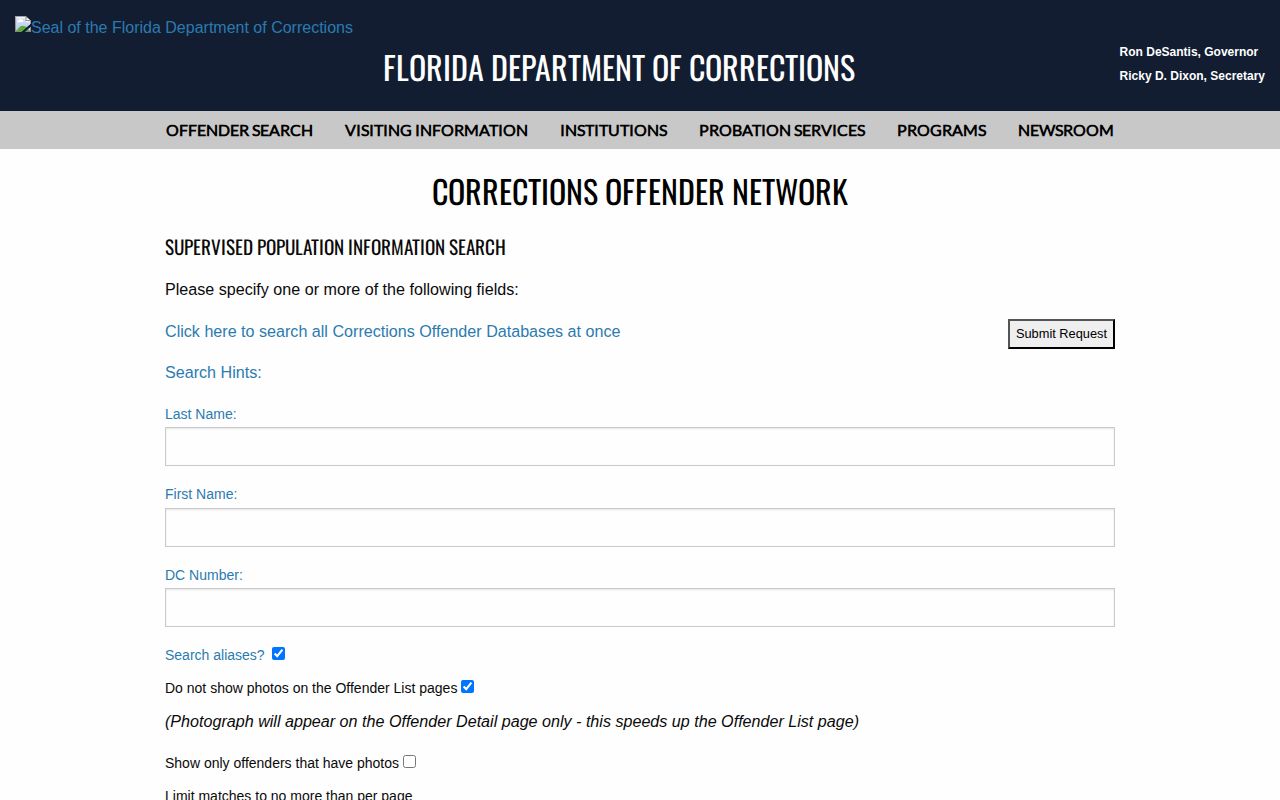
The agency and status fields matter more than a name-only match. Save the date checked because FDC records can refresh on different schedules.
Pinellas Probation Office Routes
Pinellas supervision does not run through one universal counter. FDC field offices serve state felony cases. PCSO's Misdemeanor Probation Unit serves misdemeanor sentences, and PCSO Alternative Sentencing handles listed pre-arrest, pretrial, and monitored release programs. Contact the office named on the current order or official FDC detail. Staff can explain reporting instructions, but a phone call is not a substitute for the filed court order.
PCSO Misdemeanor Probation
14500 49th Street North, Suite 130
Clearwater, FL 33762
727-464-8100
Appointments: Monday through Friday, 7:00 a.m. to 5:00 p.m., excluding holidays
PCSO Alternative Sentencing
Pinellas County Justice Center
14250 49th Street North, Suite 1300
Clearwater, FL 33762
727-464-6448
Monday through Friday, 8:00 a.m. to 4:00 p.m.
State supervision is routed through the office shown in the FDC record. The official FDC Clearwater Circuit Office list is the current office source rather than an assumed countywide assignment.
Note: Confirm office assignment from the live FDC detail because a Pinellas address does not always establish the supervising circuit.
Pinellas Supervision Status Terms
Conditions come from the court order or FCOR release document. They may govern reporting, travel, treatment, testing, contact, restitution, or monitoring. The exact order controls. An online summary should not be used to guess what one person may do. PCSO's pretrial programs can include weekly contact, GPS, alcohol monitoring, or other court-set limits, but those are pending-case terms and must not be relabeled as parole.
FDC defines Active as active supervision in the community. Active Suspense means the person is temporarily unavailable for direct supervision, often because of confinement in another place, while FDC still monitors the case. It is not proof of release. An absconder is a person whose whereabouts are unknown to supervision and for whom a violation warrant has issued. That label means alleged noncompliance, not freedom from legal control.
When the detail says absconder or fugitive, use FDC's separate Absconder/Fugitive search and contact FDC for the current status. A jail roster may also show a new custody event, while the Pinellas Clerk docket may show a violation filing or warrant action. Do not infer the result from a stale screen.
How Pinellas Supervision Ends
Supervision ends through an official termination, discharge, sentence expiration, or court action, depending on the program. The scheduled termination date is a plan, not final proof. Look for a terminated or prior status in FDC and compare it with the Clerk's filed termination order. For parole and FCOR programs, request the Commission action or discharge record when the public screens do not state the result clearly.
FCOR publishes a voting schedule and date-specific agendas. An agenda shows that a case was set for consideration, but it does not prove the vote. The reliable path is calendar, agenda, then action sheet or order. The Commission Clerk can provide action records, and FCOR accepts public-record requests. A decision may grant, deny, defer, modify, or rescind an action, so the exact document should supply the wording.
The original county custody event remains separate. Use the Pinellas County released-inmate search and records path to confirm when PCSO custody ended, then use the supervision record to establish whether legal oversight continued.
Pinellas Parole Action Records
FCOR parole eligibility is unusual in modern Florida. The offense date and statutory category matter more than sentence length alone. Florida Statutes section 947.16 sets an interview framework for eligible cases, while FCOR explains the older offense and special-category limits. A Pinellas conviction does not make a person parole eligible by itself.
The FCOR Commission Voting Schedule lists dates chosen by the Commission. Date-specific agendas can show the person's name, DC number, county, offense, case number, category, and whether the full Commission or a panel acts. An agenda proves only that an item was scheduled. It does not state that parole was granted, denied, or modified.
For the result, request the action sheet or order from the Commission Clerk. FCOR says a request may be oral and anonymous, while any invoiced charge must be prepaid. The Clerk can be reached at 850-488-1293; the public-record route lists fcorlegal@fcor.state.fl.us and 850-848-4460. Ask for the date, DC number, case, and exact action document.
This record chain also prevents a future agenda date from being mistaken for a release date. Even a favorable FCOR action may carry conditions or require later processing before physical release and field supervision begin.
Pinellas Reentry After Release
Release and reentry support are not proof of supervision status. Pinellas County Justice Coordination maintains a Community Re-Entry Resources hub and lists 727-453-7441 for help navigating local resources. PCSO's handbook also points to discharge planning with a social worker and the 211 referral line. Those routes may help with documents, transit, legal needs, or other basic steps after release.
Verify release first through PCSO or FDC. Then verify supervision through the agency that owns the case. A referral, intake, or use of a reentry service does not show parole, probation, or discharge. The distinction protects against reading a service record as a corrections record.
Note: Reentry staff can route services, while only PCSO, FDC, FCOR, or the court can confirm the legal status.
Pinellas Property and ID After Release
PCSO property rules create a separate post-release task. The inmate handbook allows a request to mail property during custody or within 30 days after release or transfer through its Release of All Property and postage process. The outside recipient generally needs valid photo identification. This process concerns personal property from the jail episode, not Property and Evidence held for an investigation.
For identification documents, Pinellas County's Important Documents resource routes people to official replacement channels. If a projected jail release date looked wrong while the person was confined, PCSO directs an Inmate Request to Inmate Records through the kiosk or tablet. After release, contact Records or Inmate Records and describe the booking episode rather than expecting an unpublished correction form.
Property pickup, document replacement, and supervision reporting can have different deadlines. None changes the recorded release date by itself. Keep the jail docket number, FDC DC number, court case number, and supervision contact separate so each office can locate the right record.