
Pinellas County Jail Release Paths
Pinellas County Jail is the main county intake, detention, and release point. The Pinellas County Sheriff's Office operates it as one compound. South, Central, and North are divisions of that compound, not separate jails with separate searches. Central Booking and Release handles physical intake and release. Inmate Records reviews commitment papers and documents each release. That division of work matters because a court ruling may come first, while records checks and physical processing occur later.
A person may leave after bond, a judge's order, completion of a county sentence, or resolution of charges. Those paths can return someone to the community. Other departures are transfers. A status that names FDC, another county, the United States Marshals Service, or ICE means the PCSO custody episode ended, but confinement may have continued. The exact status line and receiving agency are therefore more useful than the word “released” standing alone.
| Departure shown | What it means | Next source |
|---|---|---|
| Bond or court order | Community release subject to the court case and any conditions | PCSO status and Clerk case |
| County sentence complete | The jail term ended | Release record and sentencing order |
| Transfer to FDC | State custody began | FDC Offender Search |
| Other county, USMS, or ICE | Custody shifted to another authority | Transfer record and receiving system |
Confirm Pinellas County Jail Release
The official PCSO Arrest Inquiry includes people now incarcerated and people released during the prior 30 days. Search the person, open the correct booking episode, and read the Cell Location/Status line. A recent detail may show the timestamp and mechanism, along with the docket, booking date, charges, bond information, and a projected release field. Match at least two identifiers. One name can belong to more than one person, and one person can have more than one booking.
- Search by full name, docket number, or booking date. Start broad, then narrow with the available identity fields.
- Open the matching episode. Compare docket, booking date, agency, physical descriptors, and court case.
- Read the actual status timestamp and release mechanism. Do not substitute “Proj Release Date” for a completed release.
- Follow any named receiving agency. A transfer ends the county episode, not all custody.
- Check the Pinellas Clerk case for the order, disposition, sentence, or bond action that explains the legal result.
For a fuller search and records path, the Pinellas County released inmate search explains how county, state, court, federal, and immigration sources fit together.
Pinellas County Jail Release Records
The live inquiry is a useful first check, but it is not the whole record. Ask Inmate Records or the PCSO Records Section for the booking sheet, release screen or log, exact release date and time, release reason, authorizing document, receiving-agency entry, and booking photograph when needed. A narrow request is easier to locate. Include the full name, docket number if known, and an approximate booking or release range.
Requests can be filed through the PCSO GovQA Records Portal, by phone, email, mail, or contact with the Records Section. PCSO will identify responsive material and any cost before production. The research found no fixed price or promised turnaround for this release package, so neither should be assumed. The Clerk's court record remains a separate source. It explains the charge disposition and order, while PCSO documents the physical custody event.
- Release screen or log
- The agency entry recording when and how the jail episode ended.
- Release authorization
- The order or clearance supporting the physical departure.
- Transfer entry
- The record naming an authority that accepted custody.
- Discharge
- The end of a custody or supervision term, not merely movement between sites.
Note: The 30-day limit governs the public web display, not the existence of every underlying PCSO record.
Pinellas County Jail Release Contact
The jail information line addresses facility and booking matters. Archived release material belongs with the Records Section. These functions should not be merged with the Clerk, even though the Justice Center stands next to the jail. The sheriff records physical custody, while the Clerk maintains the court case and filed orders.
14400 49th Street North
Clearwater, FL 33762
727-464-6415
10750 Ulmerton Road
Largo, FL 33778
727-582-5865
prr@pcsonet.com
Mail: P.O. Drawer 2500, Largo, FL 33779-2500
The PCSO contact source shows the jail and Records Section routes. The image below records that official contact context.
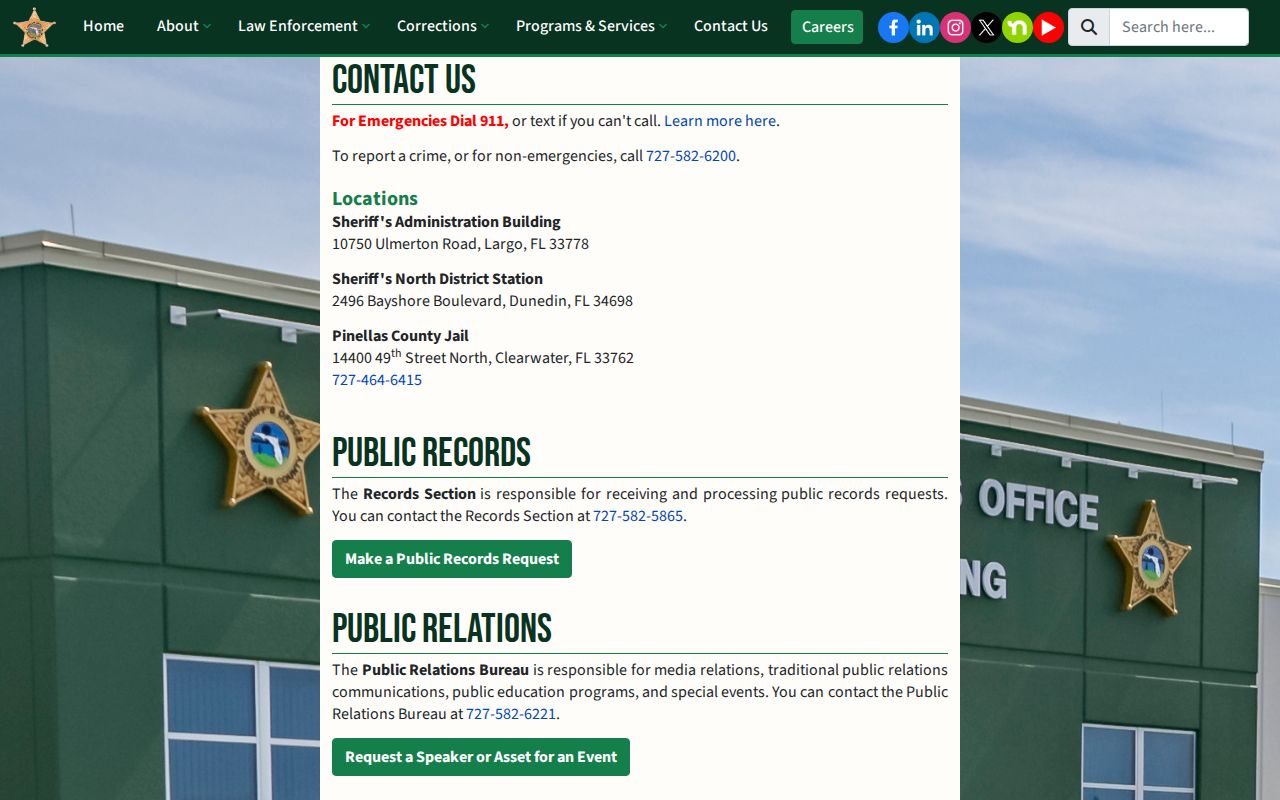
These contact channels help distinguish a booking inquiry from a formal record request. The requested document name and docket number should be stated at the start.
Pinellas County Jail Release Site
PCSO reports roughly 1,600 beds in South Division, 1,000 in Central, and 785 in North. It also describes an average daily population near 3,000. These figures explain the size of one compound, not three independent detention centers and not a current census. One Arrest Inquiry covers all divisions. Central contains Intake Booking and Release, which is why a person housed elsewhere in the compound still leaves through a shared release process.
People held here include pretrial detainees, people serving county sentences, and some people held for other authorities. A federal or immigration hold does not make Pinellas County Jail a federal prison or ICE detention center. The status and transfer paperwork identify the controlling path.
Pinellas County Jail Release Processing
PCSO describes a concrete release sequence. A person called from an assigned unit gathers personal and jail-issued items, moves to dress-out, receives property, and receives money at a separate point. A judge's release order does not skip clearance. Inmate Records checks other cases, holds, and documents, so someone may return to an assigned unit while that review takes place. PCSO warns that clearance can take several hours. No official fixed daily gate time was found.
Courtroom release is limited to eligible circumstances and needs a prefiled “Application for Release Pending Not Guilty Verdict,” approval, and records clearance. Jail clothing can still require normal processing. This explains why the time of a judge's ruling can differ from the jail release timestamp. When timing matters, use the final PCSO status or release log rather than estimating from a hearing time.
Property also follows its own rules. The handbook permits a request to mail property during incarceration or within 30 days after release or transfer through the Release of All Property and postage procedure. The outside recipient generally needs valid photo identification. Investigative Property and Evidence is a separate category. Note: Release processing ends only after the facility completes its checks, property steps, and final custody entry.
Safe Harbor and Jail Release
Pinellas Safe Harbor sits adjacent to the jail, but it is not a detention facility and does not prove a person's release. PCSO describes it as a jail-diversion and service site. Before release, people may speak with an assigned-area social worker about discharge planning. Service intake depends on current suitability and availability. Safe Harbor may be part of planning, yet the PCSO release record remains the proof that jail custody ended.
The distinction prevents a common error. Geographic proximity does not make Safe Harbor another jail division, a receiving-custody agency, or a substitute records office. A person can be referred to a service without being admitted, and participation says nothing by itself about the legal outcome. Verify the release first, then use service sources for practical needs.
The official Pinellas Community Re-Entry Resources hub offers navigation at 727-453-7441 for identity documents, transport, court, supervision, and other local needs. It is a support channel, not a custody locator.
After Pinellas County Jail Release
A confirmed community release may still involve a pending case, pretrial conditions, probation, registration, or another legal duty. A bond entry shows a route out of jail, not dismissal. A sentence-complete status ends the identified jail term, but another case or hold can affect what follows. Use the Clerk's case number from the booking detail to read the filed order and disposition.
Transfers require a different search. FDC covers a person admitted to Florida state custody. The BOP locator is for federal Bureau of Prisons custody, while USMS lacks a general public release locator. ICE's locator applies when immigration custody is plausible. Each system describes its own episode. A release from PCSO can coexist with custody elsewhere.
Where does someone go after release? The answer comes from the mechanism. Bond, court order, or sentence completion may lead to the community. A named receiving agency means follow that agency. When the status is unclear, request the release and transfer documents rather than drawing a conclusion from roster absence.